
Sewell Sillman: In Process
Sewell Sillman: In Process presents a group of works on paper from the 1970s that illuminate the American abstract artist's working methods and his skillful command of color, line, and geometry. These intimate works in graphite, pastel, watercolor, and collage reflect a mind in perpetual motion, an ever-searching eye, and a hand of exacting precision. Many were made during a period when Sillman produced relatively little—perhaps owing to his considerable commitments as a teacher, publisher, and traveler—yet they stand as testament to a career spent pushing the limits of visual possibility.
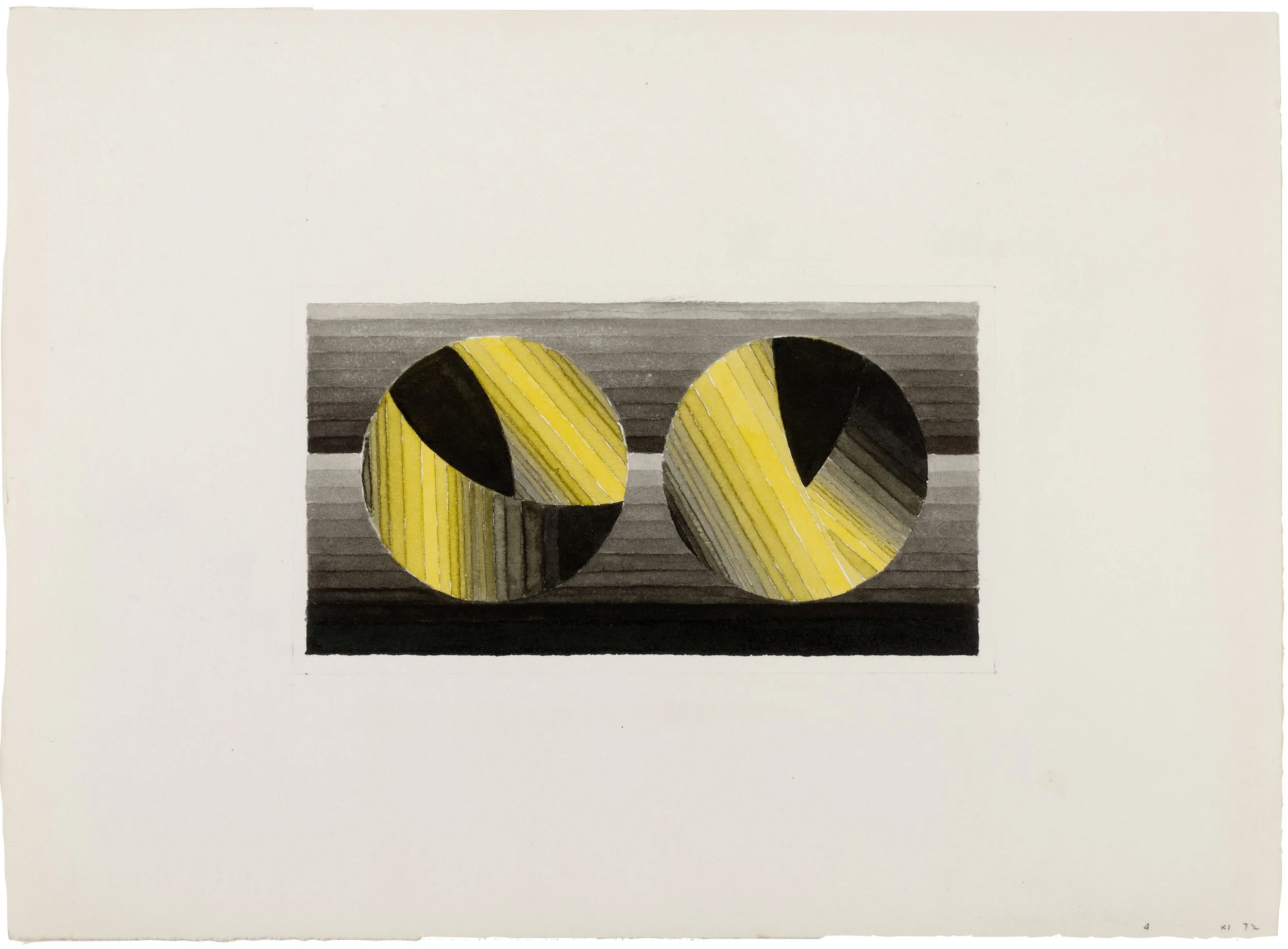
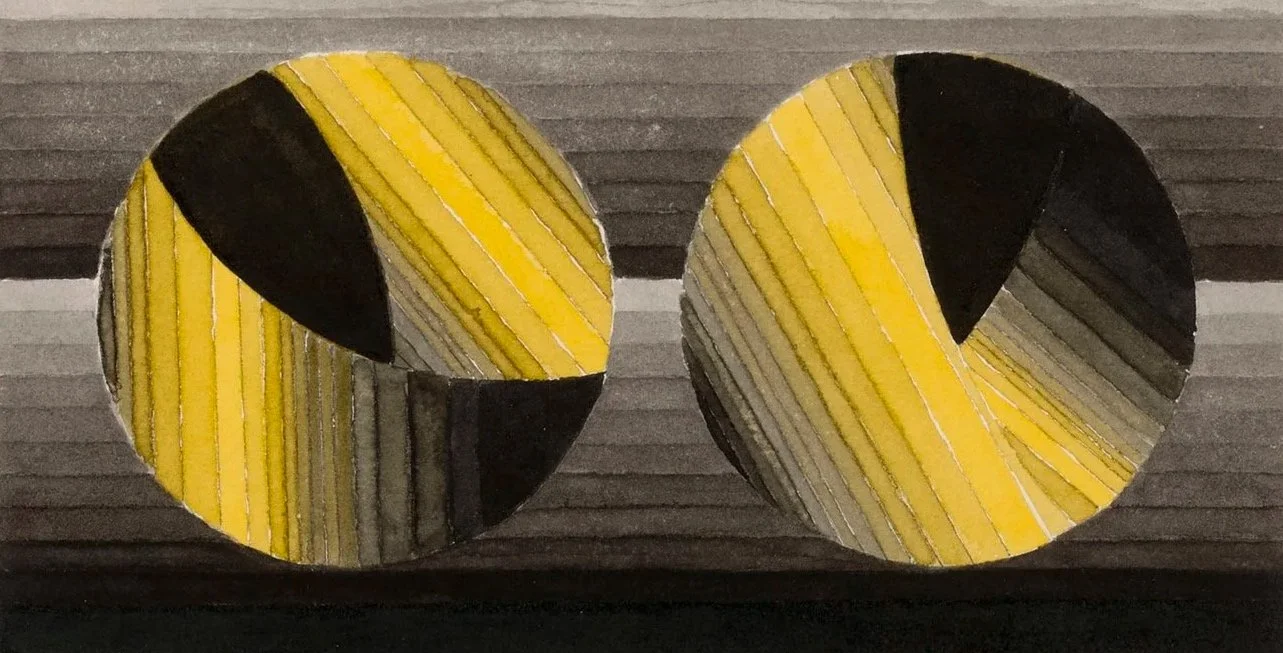
Sewell Sillman, Irreversible, 1972, watercolor and graphite on paper, 11 x 15 inches
Underlying it all was a simple question. Like his mentor Josef Albers, Sewell Sillman (1924–1992) believed that art resided in the process, not the product. As Sillman said of his Bauhaus teacher, "Albers taught us that it was all a 'question-question' game. He gave us questions, for which in turn we would find questions." Sillman's own unpretentious investigations raise questions that are formal, chromatic, and philosophical, showcasing virtuosic skills first developed at Black Mountain College and later at Yale. As art historian Amanda C. Burdan writes, "His persistent engagement with seemingly simple problems proves they were not just hollow exercises to be carried out in freshman year classes, but vital questions to be addressed again and again."
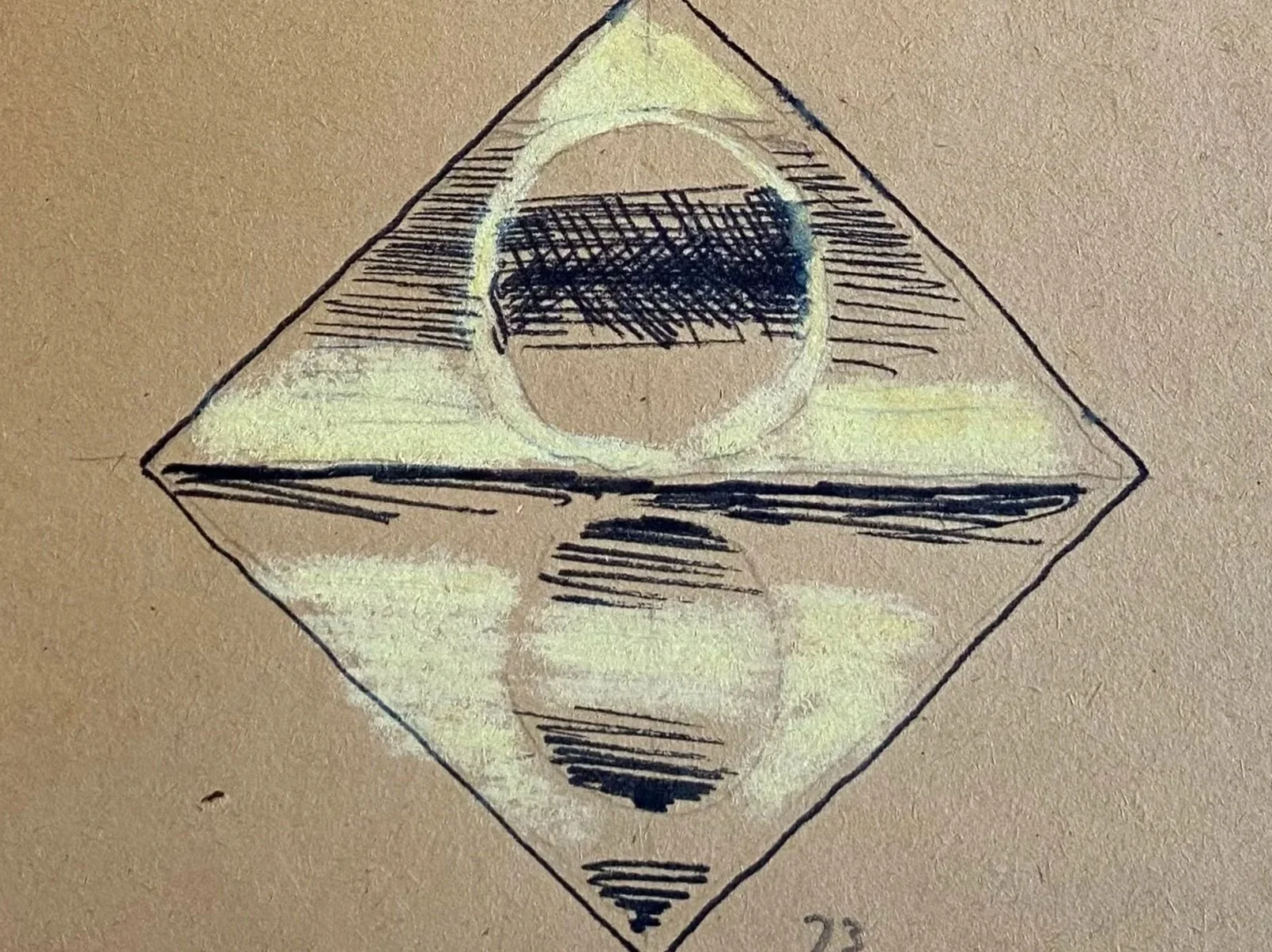
Irreversible (1972) exemplifies this principle. Art critic Vivien Raynor, writing in The New York Times in 1988, described such works as Sillman's "brilliantly hued watercolors of orbs striped as if seen through louvers." The drawing also showcases Sillman's fascination with the "orb" motif, which first appeared in his wave drawings and prints of the late 1960s and early 1970s. This bold watercolor features a pair of circles bisected by curving yellow and black bands that offer glimpses of darkened interiors, set against a tonal gradient. By overlaying the orbs with lattices of varying thickness, tilting them at different angles, and filling the voids with painstakingly controlled washes, Sillman conjures a scintillating visual field that seems to spin or slide. A related pastel and ink study from 1970 pursues a similar effect, though by swapping watercolor for pastel Sillman admits a degree of unruliness not typical of the former medium.
![Sewell Sillman, Untitled [Sketch], c. 1970, graphite on paper, 11 5/8 x 7 7/8 inches](https://images.squarespace-cdn.com/content/v1/63b70e331deebc318f75001b/1773330753237-9J3S0XMDI9JS8SD61N8X/sillmansketch1.jpg)
Sewell Sillman, Untitled [Sketch], c. 1970, graphite on paper, 11 5/8 x 7 7/8 inches
![Sewell Sillman, Untitled [Sketch], c. 1970-1973, ink, graphite, charcoal, and pastel on paper, 9 x 6 5/8 inches](https://images.squarespace-cdn.com/content/v1/63b70e331deebc318f75001b/1773330780258-7MY9COXXEXH6R40OWJ9I/sillmansketch2.jpg)
Sewell Sillman, Untitled [Sketch], c. 1970-1973, ink, graphite, charcoal, and pastel on paper, 9 x 6 5/8 inches
![Sewell Sillman, Untitled [Sketch], c. 1977, ink and graphite on paper, 5 x 5 inches](https://images.squarespace-cdn.com/content/v1/63b70e331deebc318f75001b/1773330807512-1CWCNN0W42HY3GSVIGJ6/sillmansketch.jpg)
Sewell Sillman, Untitled [Sketch], c. 1977, ink and graphite on paper, 5 x 5 inches
![Sewell Sillman, Untitled [Sketch], 1977, graphite on paper, 5 x 8 inches](https://images.squarespace-cdn.com/content/v1/63b70e331deebc318f75001b/1773330846688-FW1QKZ0SI47NHT5VPRBQ/sillmansketch3.jpg)
Sewell Sillman, Untitled [Sketch], 1977, graphite on paper, 5 x 8 inches
A graphite work from around 1970 presents a pair of compositions in diamond format—a favorite of Sillman's—each containing spiraling undulations. These dual studies take a fluid, casual approach to his iconic wave drawings, the shading more probing and sketchy than in his more finished work. Pinholes scattered across the surface speak to their provisional nature, foregrounding the process of making over any pretense of pristine finish.
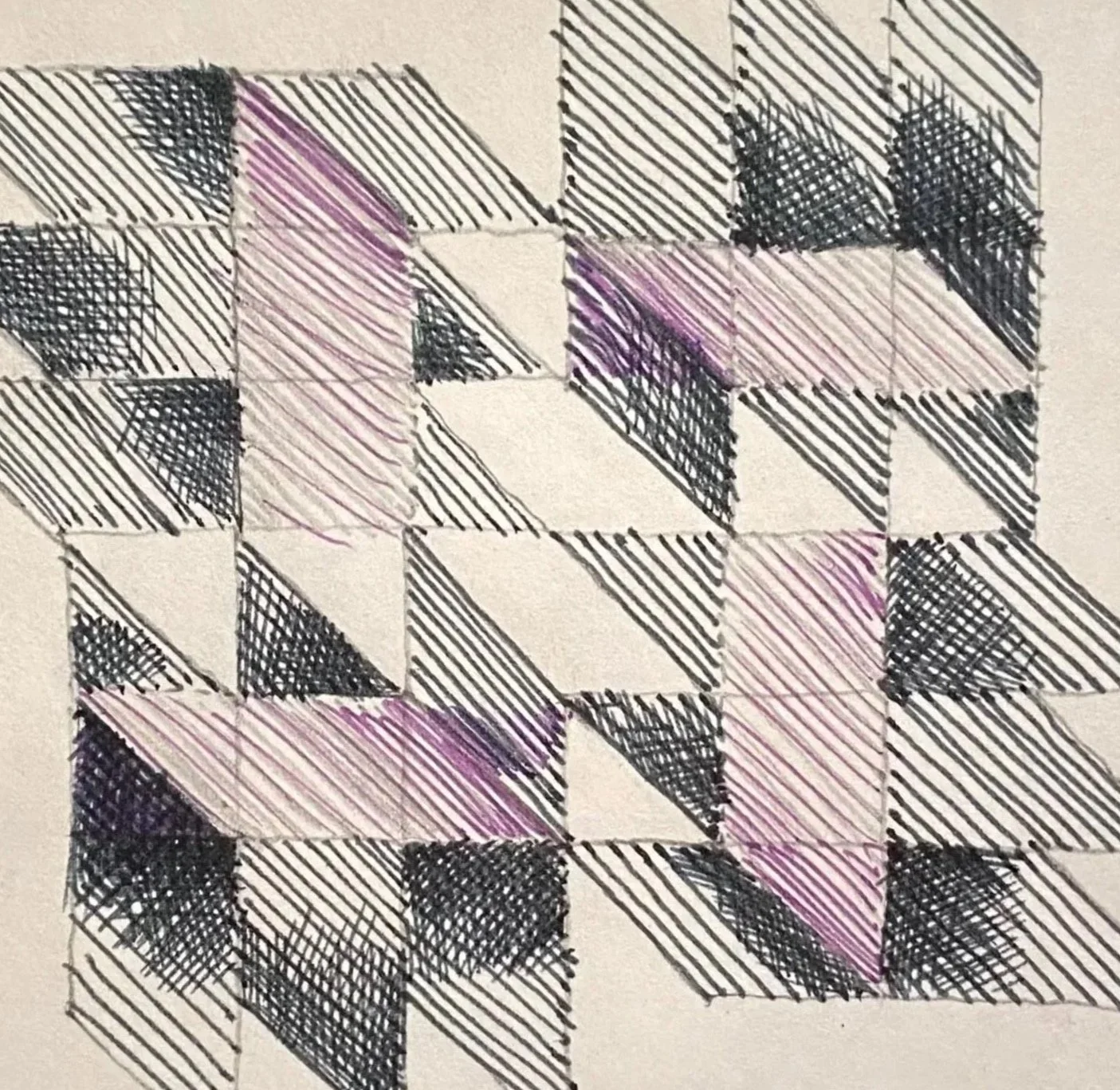
In the collage The Sixth Orb (Zurich) (1973), Sillman invokes the use of colored paper—rather than paint—from Albers's design courses. Like those early exercises, this work puts into practice experiments with gradation, volume, texture, tone, and temperature, while extending the formal vocabulary of the orb. That motif would be gradually abandoned through the 1980s as Sillman developed a parallel set of forms he called "flèches." In a smaller horizontal sketch, four orbs appear to interweave among cascading diagonal strokes, growing barely visible. In a pinwheel sketch from around 1977, the orb has been dispensed with entirely, as Sillman begins exploring a new visual grammar on its own terms.
The sheer inventiveness of Sillman's idiosyncratic vision built on his predecessors while remaining singular. He resists easy categorization—Constructivism, hard-edge painting, Kineticism, Minimalism all fall short. His relative lack of commercial success reflects both the rarity and idiosyncrasy of his work and, paradoxically, his considerable influence as an artist and longtime educator.
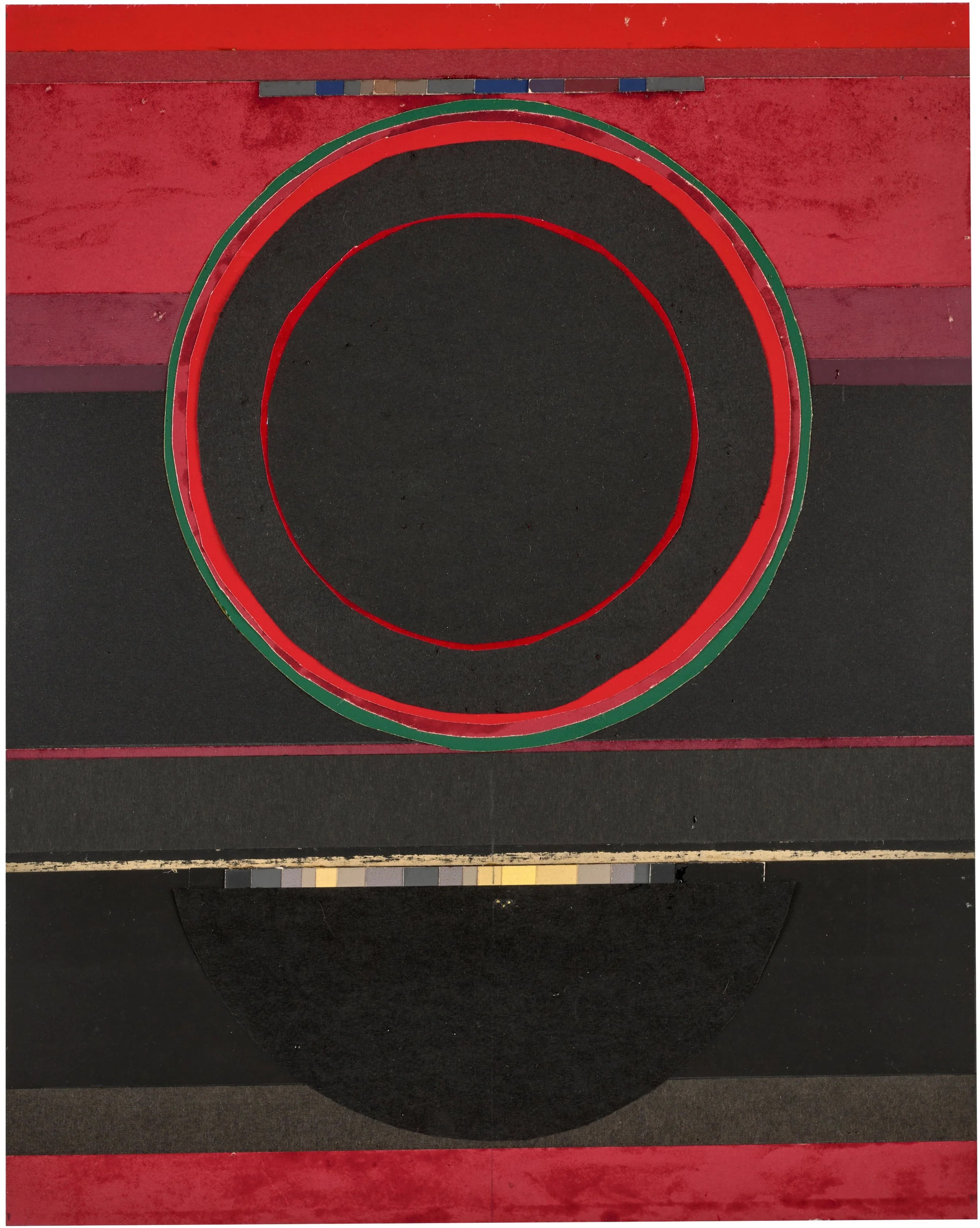
Sewell Sillman, The Sixth Orb (Zurich), 1973, mixed media paper collage, 10 1/2 x 8 1/2 inches
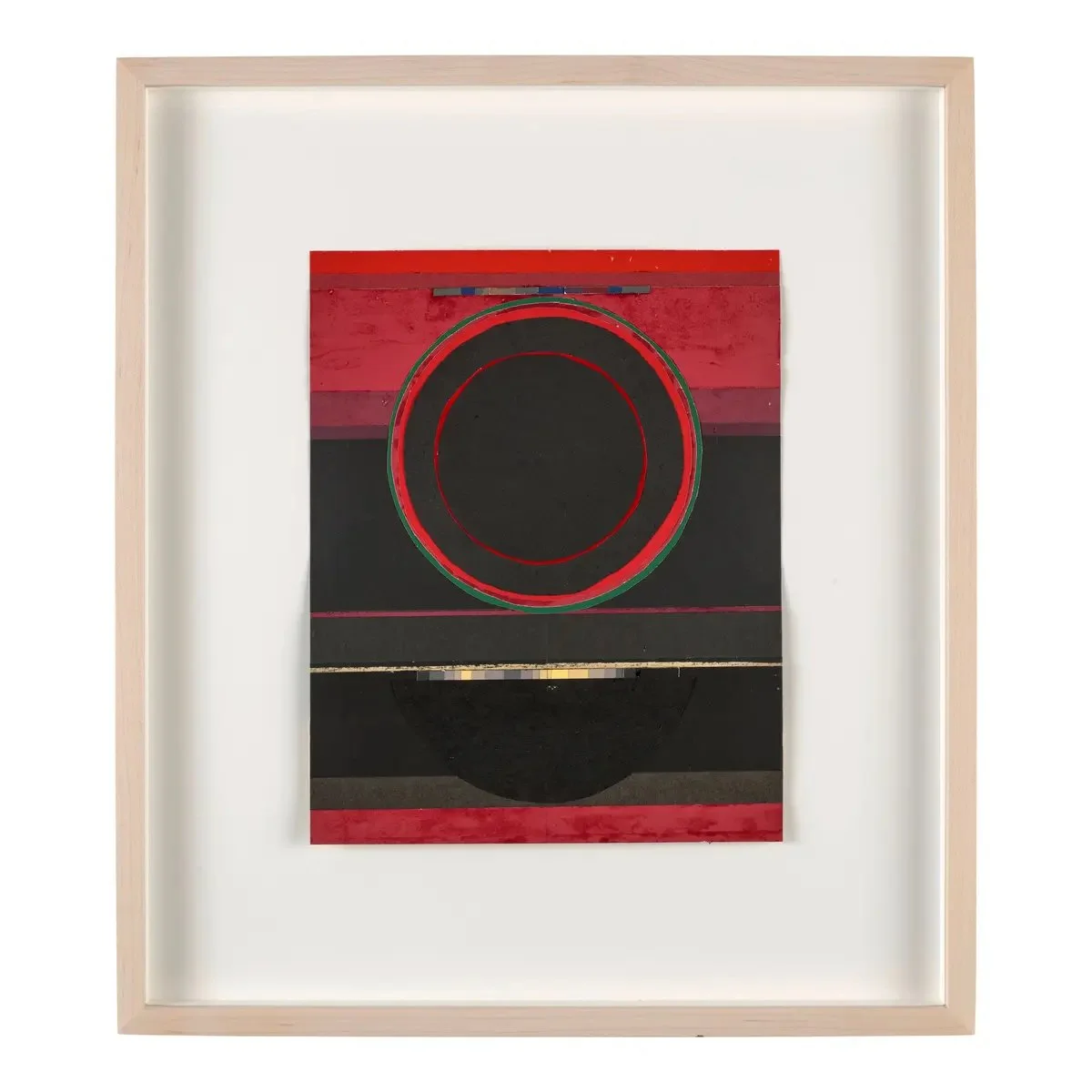
Sewell Sillman, The Sixth Orb (Zurich), 1973, mixed media paper collage, 10 1/2 x 8 1/2 inches
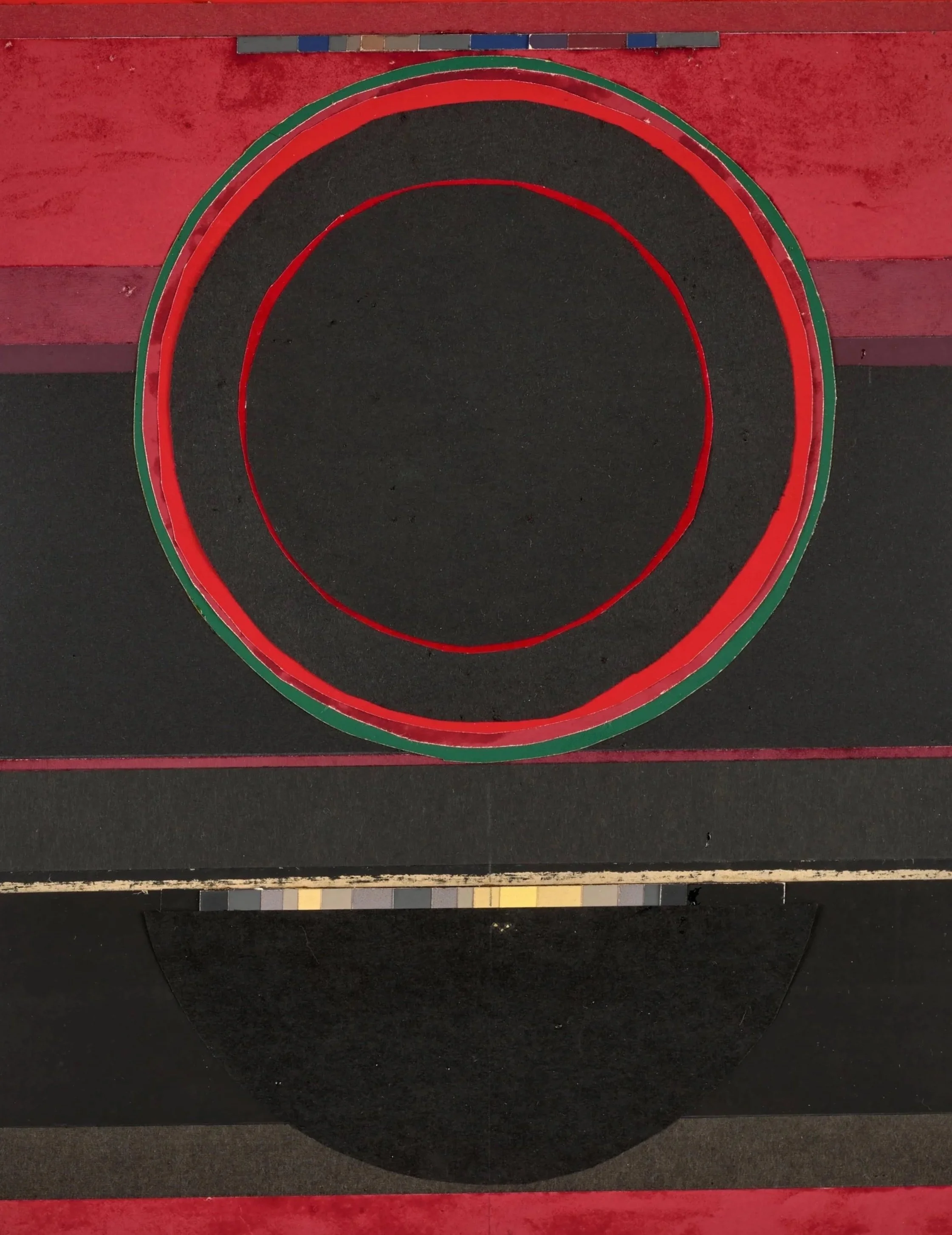
“On the whole, color is confined to the 1970s work—collages of painted papers that involve disks superimposed on one another and laid against backgrounds of horizontal stripes, and some small, brilliantly hued watercolors of orbs striped as if seen through louvers.”
- Vivien Raynor, 1988
Sewell Sillman (1924 – 1992) was an American abstract artist, educator, and print publisher.
Sewell “Si” Sillman was born in 1924 in Savannah, Georgia and attended high school in Atlanta. In 1942, Sillman enlisted in the U.S. Army Air Force Reserve while pursuing studies in civil engineering at Georgia Tech and later at Johns Hopkins. He saw active duty at the European front in 1944 and 1945 and was wounded at the Battle of the Bulge. After the war, Sillman re-enrolled at Georgia Tech, this time with a focus on architecture. Disaffected with the atmosphere, Sillman soon followed friends William Ragland Watkins and Albert Lanier to Black Mountain College in Asheville, North Carolina. Sillman recalled that Black Mountain College “…gave me a chance to get rid of absolutely every standard that I had grown up with… It was like a snake that loses its skin…What was left was someone who had absolutely no idea in the world what to do…It was marvelous.” Faculty at Black Mountain included Anni and Josef Albers, Buckminster Fuller, Merce Cunningham, Willem de Kooning, Walter Gropius and Robert Creeley. Among Sillman’s fellow students were Ray Johnson, Kenneth Noland, Robert Rauschenberg, and Susan Weil.
Sillman continued his architectural studies with Buckminster Fuller, but it was his introduction to Josef Albers that would change the course of his career. Of Albers, Sillman said, “What you get from Albers is not something that you can codify, that you can exhibit, that you can mine and make a buck with…It’s basic soul study in a sense. It goes inside of you.” Albers left Black Mountain in 1949 and accepted the position of head of the Department of Design at Yale, where Sillman soon followed, earning his BA in 1951 and his MFA in 1953 with a thesis on color. He joined the Yale Department of Art faculty in 1954 teaching color, drawing and painting, and later becoming director of undergraduate programs in art. Sillman had many notable students including Bruce Helander, Newton Harrison, and Howardena Pindell, who recently stated that Sillman’s courses on color “changed her life.” Sillman went on to teach at Parsons School of Design, Carnegie Tech, Ohio State University, SUNY Purchase, Penn State University and Rhode Island School of Design.
Ives-Sillman, Inc. was founded in 1962 by Sillman and his co-worker and fellow professor at Yale University, Norman Seaton Ives. They first published, Josef Albers: Interaction of Color (1963). Other artists published include Walker Evans, Piet Mondrian, Ad Reinhardt, Jean Dubuffet, Jacob Lawrence, Romare Bearden, and Roy Lichtenstein.
Sillman’s lifelong dedication to drawing as his primary mode of expression elevated draftsmanship far above mere graphic design. His paintings, though indebted to the geometric abstractions of Albers, are less academic and and more esoteric, with some compositions appearing like otherworldly portals with hints of the sublime. He was included in the exhibition Recent Drawings, U.S.A. at The Museum of Modern Art in 1956. He was shown at the Stable Galleries and the Sidney Janis Gallery in New York and later in life at Galerie Denise René in Paris. He is represented in the collections of The Museum of Modern Art, The Whitney Museum of American Art, the Florence Griswold Museum, and The Phillips Collection, among others. Sewell Sillman died in April, 1992 in Lyme, Connecticut, where he resided with his longtime parter, James McNair.

Sewell Sillman, Announcement for Exhibition Sewell Sillman: Paintings and Drawings, Feb. 1967, Lyman Allyn Museum, New London, CT, offset lithograph on paper; tripartite foldable card, as issued; text verso, 8 3/4 x 5 3/4 (folded)

Sewell Sillman: Peintures a l'aquarelle / esquisses au crayon, poster for solo exhibition at Galerie Denise René, Paris, April, 1987, offset printed, 16 x 16 inches

Announcement for exhibition Sewell Sillman/Paintings, Madison Gallery, Madison, CT, April 23-June 19, 1988, 5 1/2 x 8 inches (folded)

Sewell Sillman: Pushing Limits, catalogue for exhibition at the Florence Griswold Museum, Old Lyme Connecticut, 2010, 9 1/2 x 9 1/2 inches
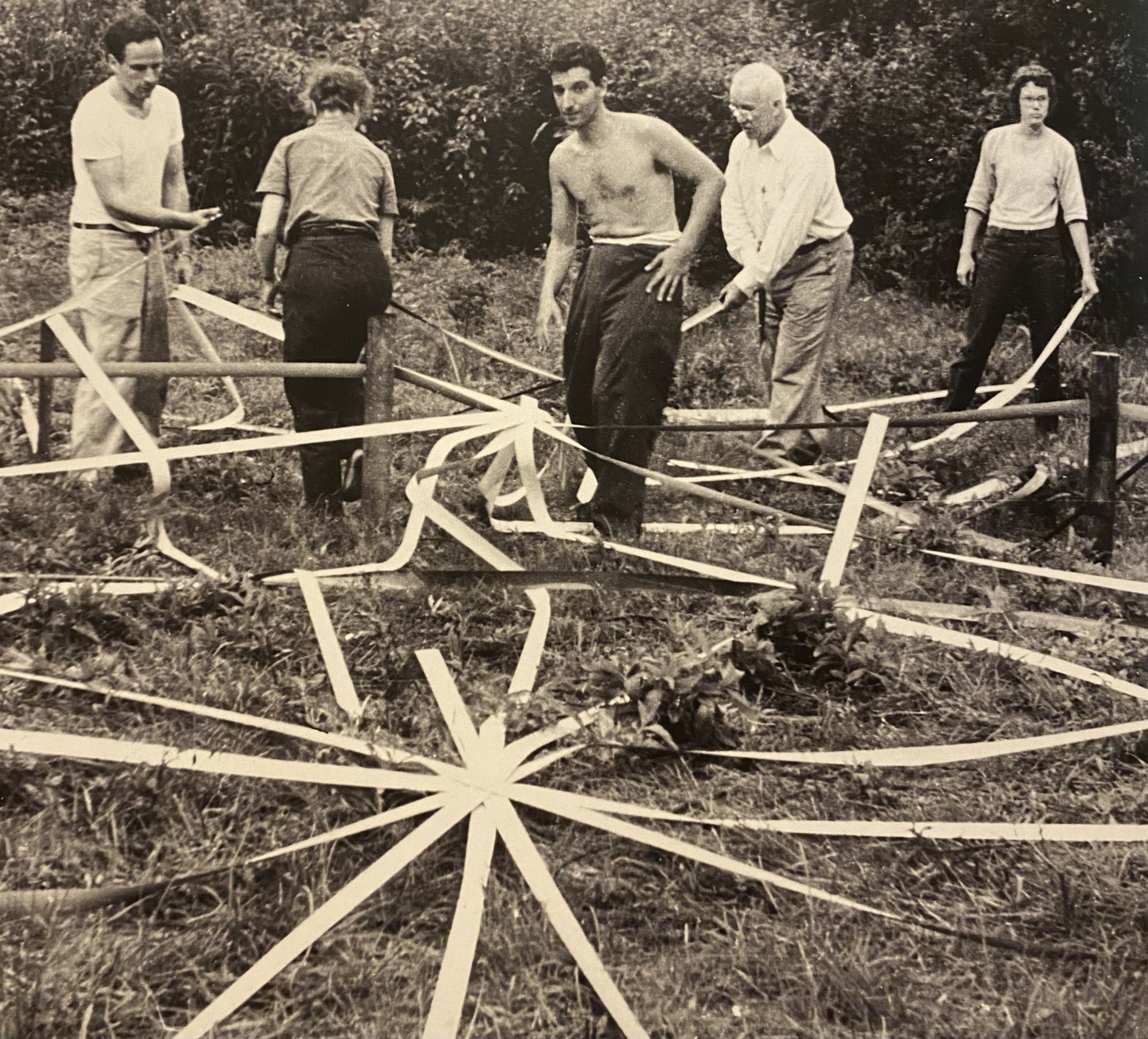
Elaine de Kooning, Sewell Sillman, and Buckminster Fuller at work on Fuller's "supine dome," summer 1948. Photo: Beaumont Newhall, courtesy of the North Carolina State Archives and Florence Griswold Museum.
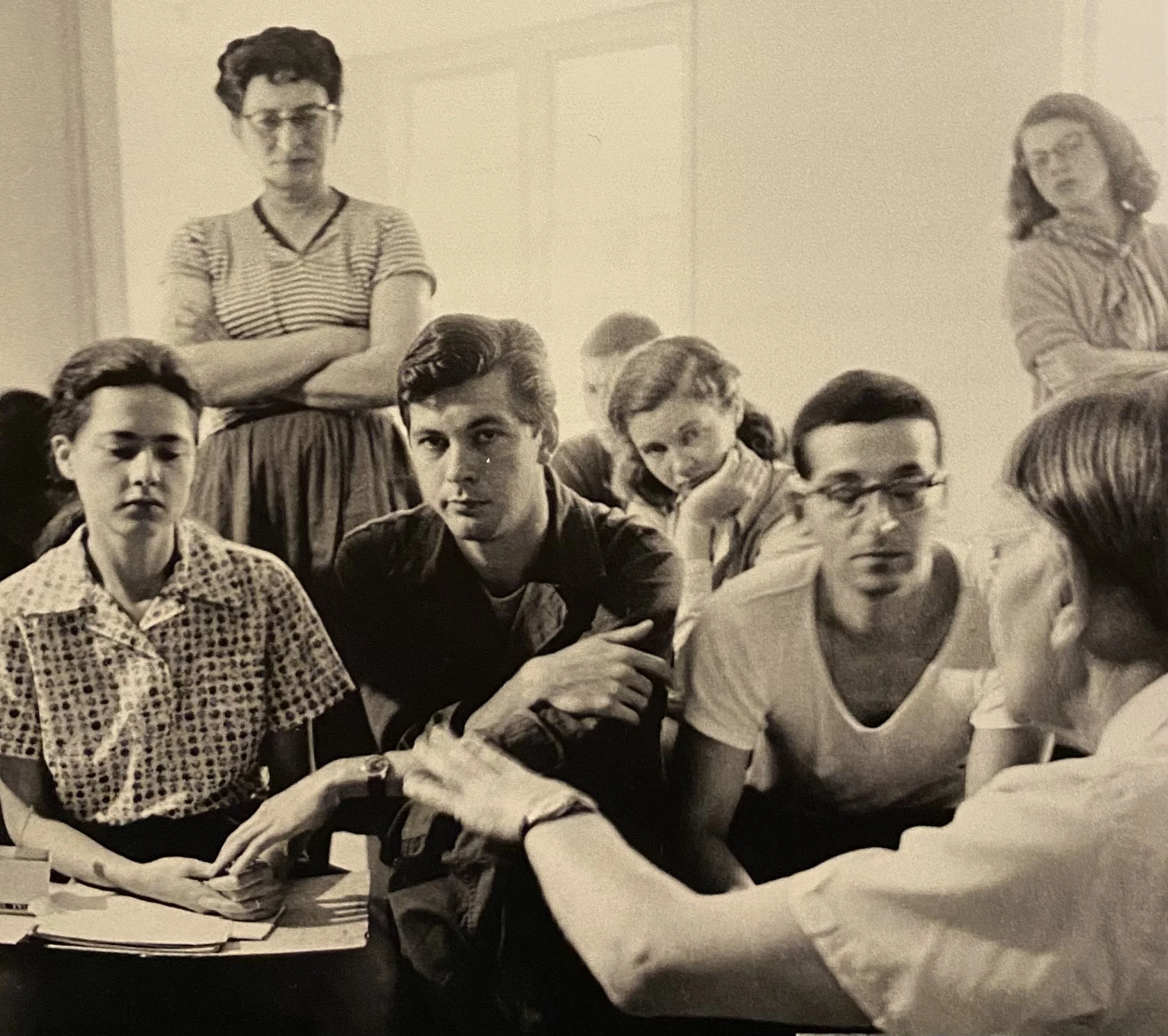
Sewell Sillman in the front row (right) of Josef Albers's class at Black Mountain College, 1948. Photo: Clemens Kalischer. Courtesy Florence Griswold Museum.
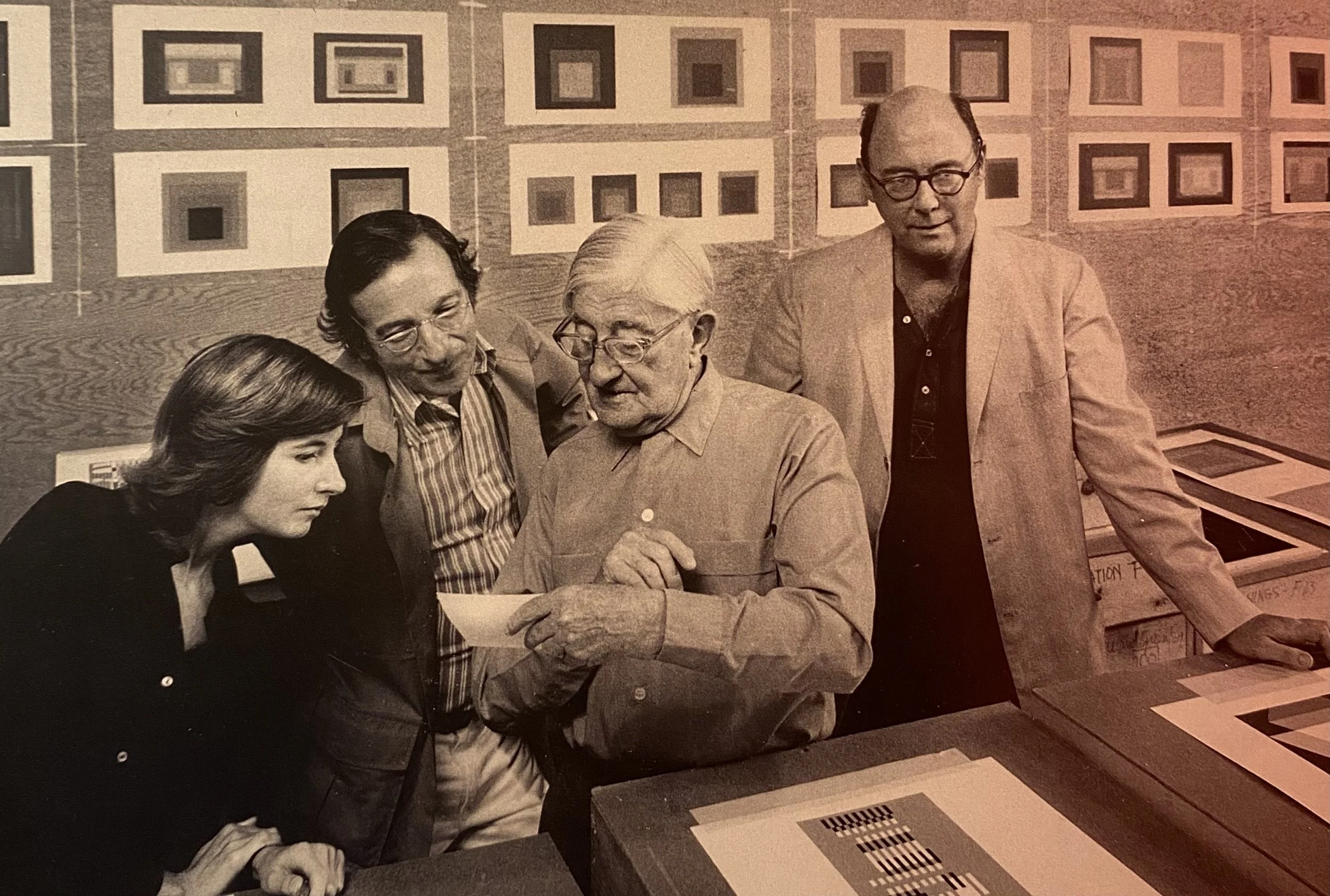
(left to right) Eugenia Joyce, Sewell Sillman, Josef Albers, and Norman Ives, during the assembly of Formation: Articulation, 1972. Photo: John T. Hill. Collection of James McNair, Courtesy of Florence Griswold Museum.
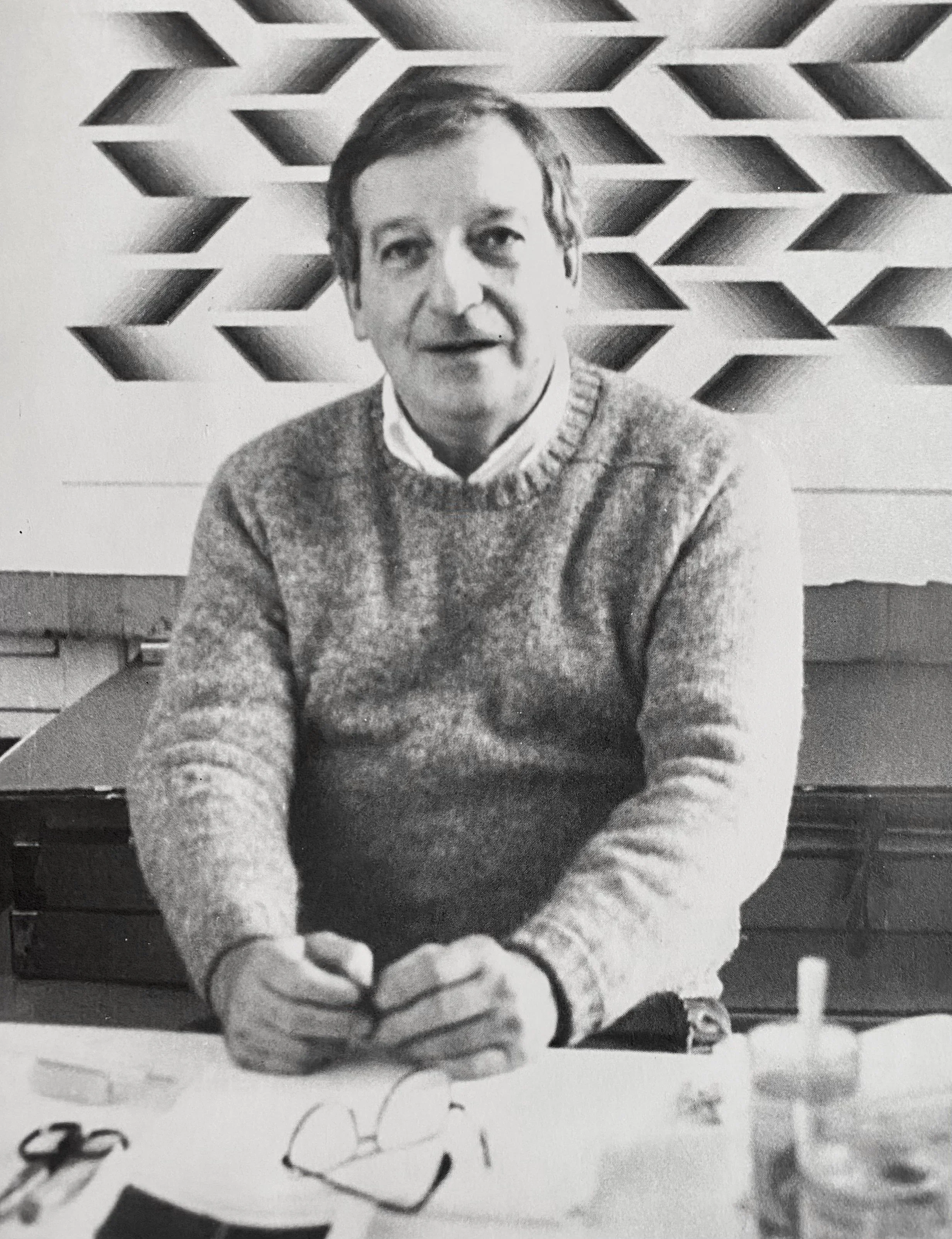
Sewell Sillman in his studio, 1983. Photo: Allen Buck, courtesy Galerie Denise René, Paris.
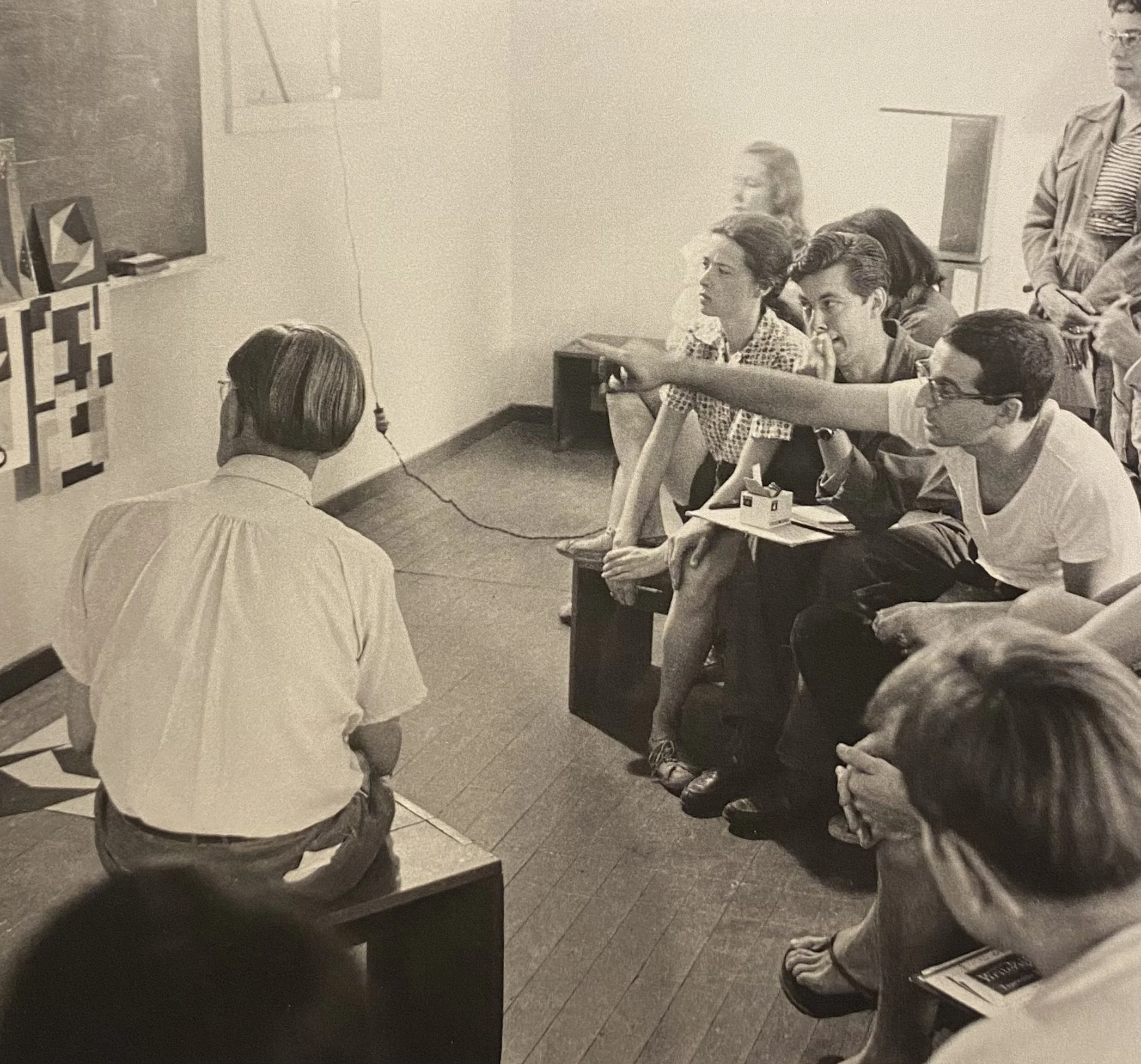
Sewell Sillman pointing in Josef Albers's class at Black Mountain College, 1948. Photo: Clemens Kalischer. Courtesy Florence Griswold Museum.
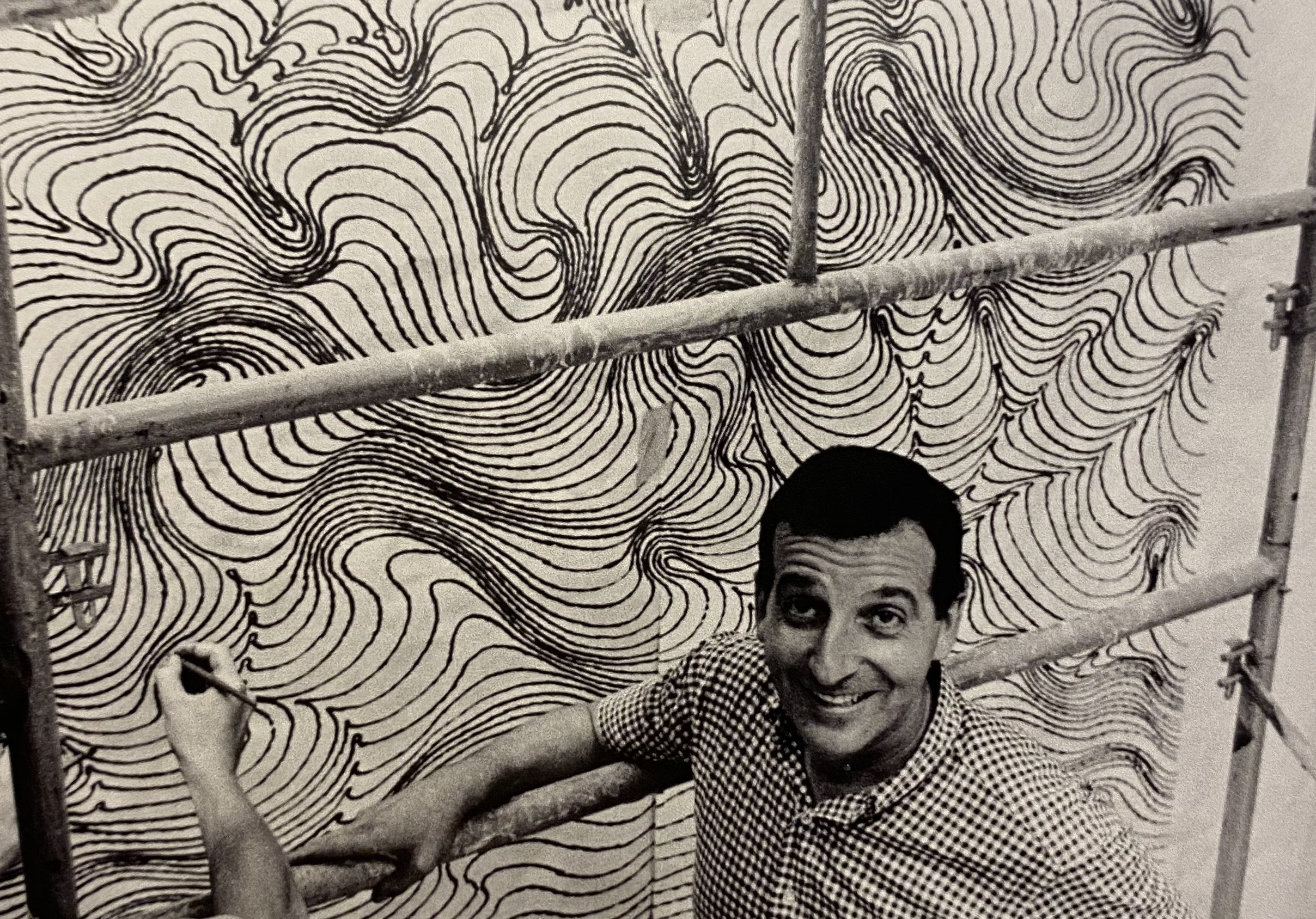
Sewell Sillman working on a mural at Yale's Art and Architecture building, 1963 (destroyed by fire in 1969). Photo: John T. Hill. Collection James McNair. Courtesy the Florence Griswold Museum.